
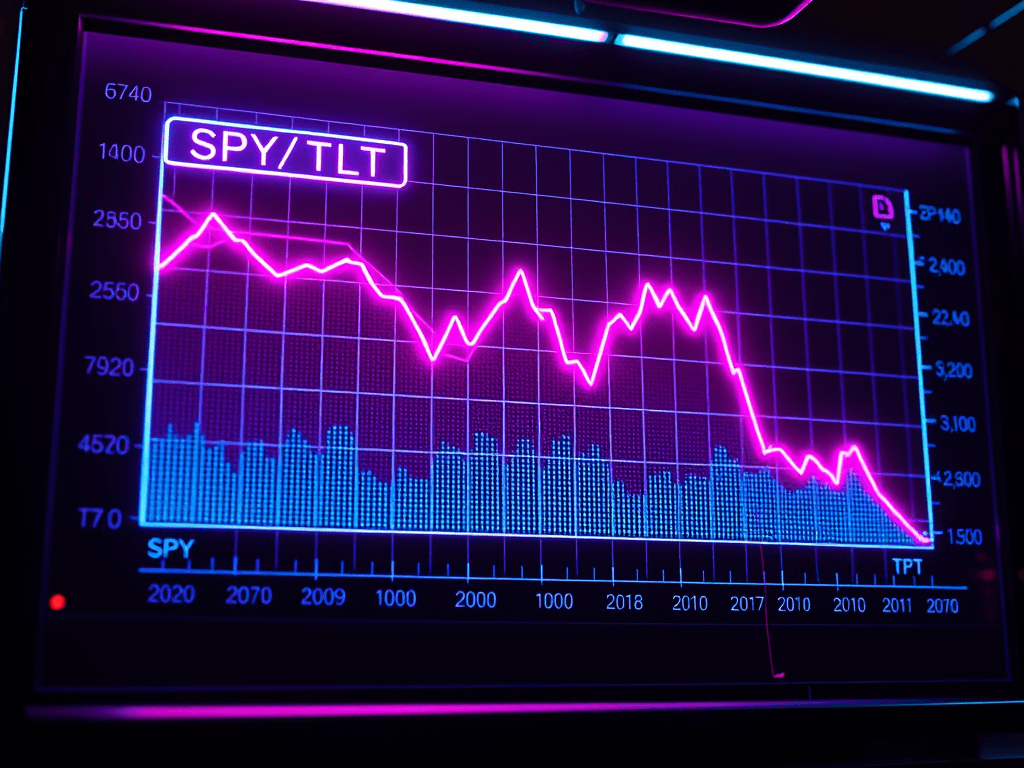
Intermarket analysis has been a cornerstone of technical analysis since John J. Murphy published Intermarket Analysis: Profiting from Global Market Relationships in 1991. While technicians have long studied relationships between asset classes, Murphy was the first to formalize a framework for using these relationships to improve portfolio performance. One of the most effective ways to assess market expectations for economic growth is by analyzing the ratio of the S&P 500 (SPY) to long-term Treasury bonds (TLT).
Why Does This Ratio Work?
SPY consists of 500 of the largest, most profitable companies in the world, with over 70% of their earnings derived from the U.S. economy. This makes SPY a strong gauge of overall economic health—when the economy is expanding, corporate earnings rise, and SPY typically follows. Conversely, during economic downturns, earnings shrink, and SPY tends to decline.
At its core, the SPY/TLT ratio measures the market’s preference for risk assets versus safe-haven assets. Risk assets, such as growth stocks in technology, consumer discretionary, and biotechnology, thrive in favorable economic conditions but are more volatile when uncertainty rises. Companies like Meta, Home Depot, Amazon, and NVIDIA exemplify this risk-sensitive group, as their valuations are highly dependent on future growth expectations.
On the other hand, TLT represents long-term U.S. Treasury bonds, which are among the safest assets in global markets. Bonds fluctuate in price based on interest rate movements—when rates rise, bond prices fall, and when rates decline, bond prices rise. The Federal Reserve and market participants both play key roles in shaping long-term interest rates, which directly impact TLT’s performance.
What Drives Long-Term Interest Rates?
The Federal Reserve influences long-term rates through monetary policy decisions. While it directly controls short-term rates via the federal funds rate, it affects long-term yields through quantitative easing (QE), quantitative tightening (QT), and forward guidance. Raising rates or reducing bond holdings (QT) puts upward pressure on yields, while lowering rates or purchasing bonds (QE) pushes yields down.
However, market participants also drive long-term interest rates by adjusting their bond demand based on growth and inflation expectations. If investors anticipate strong economic expansion and rising inflation, they demand higher yields, causing rates to rise. Conversely, during economic slowdowns or recession fears, investors flock to safe-haven assets like bonds, driving their prices up and yields down.
Long-term interest rates serve as a barometer for economic growth expectations—higher rates signal confidence in growth, while lower rates reflect concerns about economic weakness or deflationary risks.
What Is SPY/TLT Showing Today?

Chart 1.1: SPY/TLT
Understanding the historical behavior of SPY/TLT helps put today’s market action into context. Currently, we’re seeing signs of strain in the equity market, while bonds are beginning to catch a bid. This shift is reflected in SPY/TLT, which recently closed at a 13-week low—a key indicator that investors are rotating toward safety.
Why does a 13-week low matter? Public companies report earnings every 13 weeks, providing fresh data on revenue, margins, and overall business health. These earnings reports significantly influence market sentiment, leading investors to adjust their portfolios accordingly. A decline in SPY/TLT following an earnings season suggests that investors are increasingly favoring bonds over equities—a signal that economic growth expectations may be weakening.
If this trend continues, it could indicate that markets are positioning for slower growth or even a potential recession. Monitoring SPY/TLT in conjunction with broader economic data will provide further confirmation of whether this shift is temporary or the start of a larger trend.
What are Individual Equities Showing?
Looking under the hood of SPY, we’ll examine the charts of the four equities mentioned earlier, NVIDIA, Home Depot, Amazon, and Meta.

Chart 1.2: NVIDIA (NVDA)
Since bottoming in the 2022 bear market, NVIDIA (NVDA) surged over 1,000% in less than two years, leading the market’s recovery. However, since peaking in June 2024, NVDA has stalled, trading sideways for 36 weeks. The stock recently faced another rejection at resistance, signaling a potential shift in momentum.
While firm support exists around $95, a deeper sell-off in SPY could see NVDA break below this level. As the second-largest holding in both SPY and the technology sector, NVDA has been the ultimate risk-on stock in recent years. Its weakening momentum raises concerns not just for the stock itself but for the broader market and economy. If NVDA—a key driver of growth and sentiment—continues to lose steam, it could indicate a shift toward risk-off behavior, with investors bracing for economic turbulence.

Chart 1.3: Home Depot (HD)
If you have money to spend, there’s a good chance you’re shopping at Home Depot (HD). But when disposable income is tight, big-ticket purchases like outdoor furniture or power tools are among the first to be cut. That’s why HD serves as a key bellwether for the consumer discretionary sector, where it holds the third-largest weighting.
For the past 16 weeks, HD has struggled to gain traction, now hovering at key support within its trading range. If market participants believe the average American still has spending power, we need to see buyers step in and push prices back toward resistance. However, if HD breaks down further, it could signal growing consumer weakness and a shift toward more cautious spending—an ominous sign for both the sector and the broader economy.

Chart 1.4: Amazon (AMZN)
Everyone knows Amazon (AMZN)—its significance in gauging the U.S. economy needs no introduction. However, this quarter’s earnings report was brutal, sending the stock to a 12-week low. The gap down on February 7th highlighted just how poorly market participants received the results, and AMZN has been in a steady decline ever since.
What was once key support for 12 weeks has now flipped to resistance, reinforcing the downward trend. As the largest holding in the consumer discretionary sector, AMZN’s weakness signals potential trouble ahead for consumer spending and economic momentum. If the stock fails to reclaim lost ground, it could suggest that investors are bracing for softer consumer demand and a tougher economic environment.

Chart 1.5: Meta (META)
Of the four stocks mentioned, META boasts the strongest chart. As a company that generates the vast majority of its revenue from digital advertising, its performance is closely tied to economic growth. When the economy expands, businesses ramp up their marketing budgets, driving higher ad spending on platforms like Facebook and Instagram. However, during slowdowns or recessions, companies cut back on advertising, directly impacting META’s revenue.
Despite a sharp pullback, META held firm at previous resistance, which has now flipped into support—a bullish signal. This resilience offers a glimmer of hope that other risk-on stocks might stabilize and follow suit. If META can continue building strength, it could signal renewed confidence in growth stocks and broader market risk appetite.
Closing Remarks
In conclusion, the SPY/TLT ratio remains a crucial tool for assessing market sentiment and economic expectations. The recent decline in this ratio, coupled with weakening momentum in key risk-on stocks like NVIDIA, Home Depot, and Amazon, suggests that investors may be shifting towards more cautious positions. However, the resilience shown by Meta, with its strong technical setup, offers a potential sign of stabilization within the broader market. Monitoring these dynamics, along with economic data and market behavior, will be essential in determining whether this shift is a temporary adjustment or the start of a more significant trend towards slower growth or recession. As always, staying attuned to these intermarket relationships can provide valuable insights for positioning portfolios effectively in uncertain times.
Disclaimer:
The information presented in this report is for educational and informational purposes only and should not be construed as financial, investment, or trading advice. The analysis provided is based on current market data and trends, which are subject to change. Past performance is not indicative of future results, and there are risks associated with any investment strategy. Readers should conduct their own research or consult with a qualified financial advisor before making any investment decisions. The author and publisher are not responsible for any financial losses or damages that may result from the use of this information.
 Follow the Money, Trade the Trend
Leave a comment